
Chart patterns and Elliott waves
XABCD, Cypher, head and shoulders, ABCD, triangle and three drives patterns, and the five Elliott wave tools: how many points each takes and what it labels.
Free for every account. Every drawing tool works on any chart, on any asset and any timeframe, with no plan.
The Patterns group holds chart patterns, Elliott waves and cycles (cycles have their own article). You draw a pattern by clicking its turning points in order. The tool joins them, labels them and, for harmonic patterns, shows the ratios between legs.
How to draw a pattern
- 1. Open Patterns with the small arrow and pick a tool.
- 2. Turn on the Magnet so your clicks land on candle highs and lows.
- 3. Click each turning point from left to right. The labels follow your clicks.
- 4. After the last point the pattern is finished. Drag any point to adjust it.
Chart patterns
XABCD pattern
- What it is: five points, X, A, B, C and D, joined by legs, with the ratios AB/XA, BC/AB, CD/BC and XD/XA.
- Points: five clicks.
- Typical use: check how a series of swings compares with the ratios of a harmonic pattern.
Cypher pattern
- What it is: five points with the cypher ratios: AB/XA, XC/XA and CD/XC, where C goes beyond A.
- Points: five clicks.
- Typical use: the same check as XABCD, for the cypher shape.
Head and shoulders
- What it is: a left shoulder, a head and a right shoulder, with the line through the lows between them.
- Points: seven clicks.
- Typical use: mark the shape on a chart to keep its neckline in view.
ABCD pattern
- What it is: four points with the ratios BC/AB and CD/BC.
- Points: four clicks.
- Typical use: compare two similar legs and the pullback between them.
Triangle pattern
- What it is: four points, A to D, with lines along the highs and the lows that close in on each other.
- Points: four clicks.
- Typical use: outline a range that is getting narrower.
Three drives pattern
- What it is: three pushes in one direction with two pullbacks between them, all labelled.
- Points: seven clicks.
- Typical use: mark three similar pushes and compare their sizes.
Elliott waves
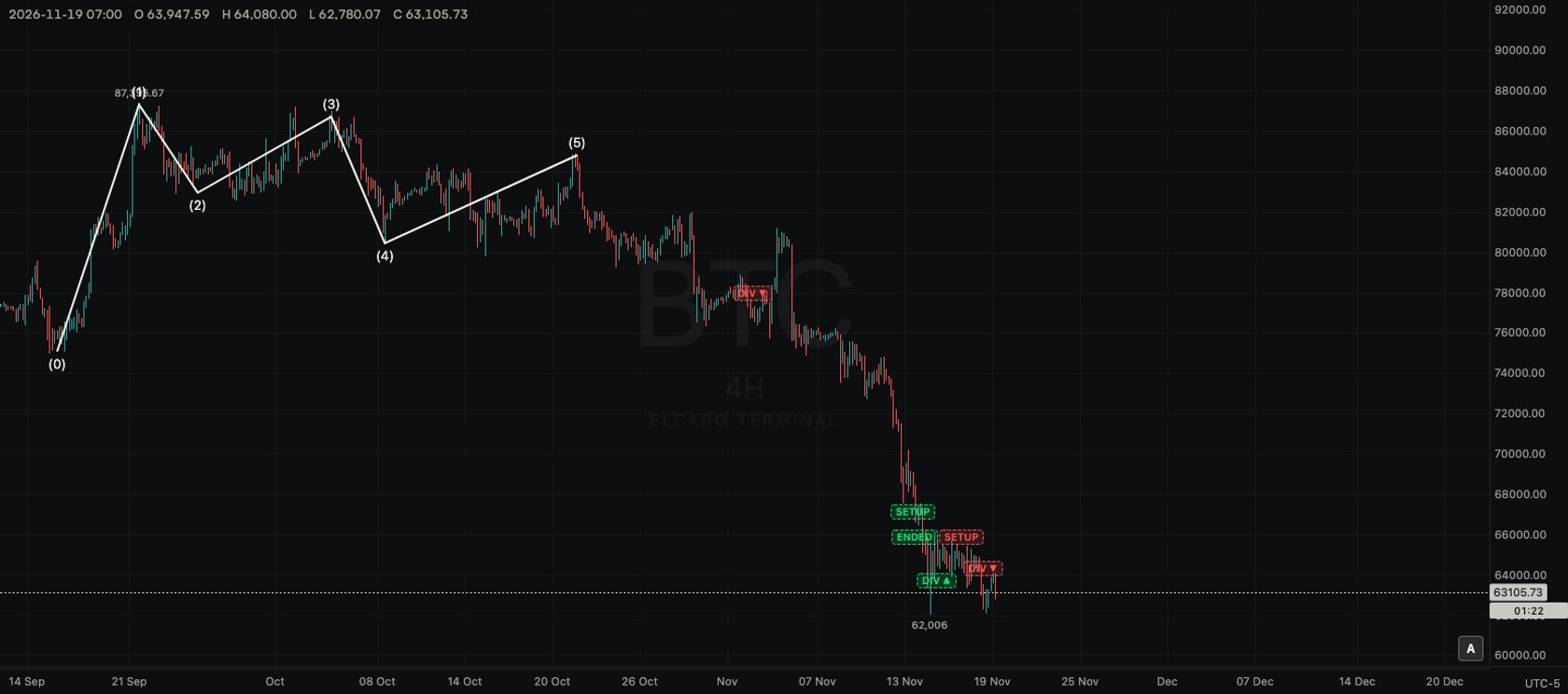
Each Elliott tool starts with a point labelled (0) and then labels every next click.
Elliott impulse wave (12345)
- What it is: labels (0) to (5) on a five-wave move.
- Points: six clicks.
- Typical use: count the waves of a move as you see them.
Elliott correction wave (ABC)
- What it is: labels (0), (A), (B) and (C).
- Points: four clicks.
- Typical use: label a three-part pullback after a move.
Elliott triangle wave (ABCDE)
- What it is: labels (0) and (A) to (E).
- Points: six clicks.
- Typical use: label a sideways stretch of five swings.
Elliott double combo wave (WXY)
- What it is: labels (0), (W), (X) and (Y).
- Points: four clicks.
- Typical use: label two corrective parts joined by a link.
Elliott triple combo wave (WXYXZ)
- What it is: labels (0), (W), (X), (Y), (X) and (Z).
- Points: six clicks.
- Typical use: label three corrective parts joined by two links.
Labels sit above highs and below lows, so the count stays readable.
Read next
Drawing tools
How the drawing toolbar works: picking a tool, placing points, selecting and styling a drawing, the magnet, drawing mode, locking, hiding and removing, undo, saving and the phone.
Cycles and projections
Cyclic lines, time cycles and sine line, plus your own sketches of a possible path: Forecast, Bars pattern, Ghost feed and Projection.
Fibonacci retracement, extension and channel
The three Fibonacci price-level tools: which points to click, which levels they draw and a typical use for each.